
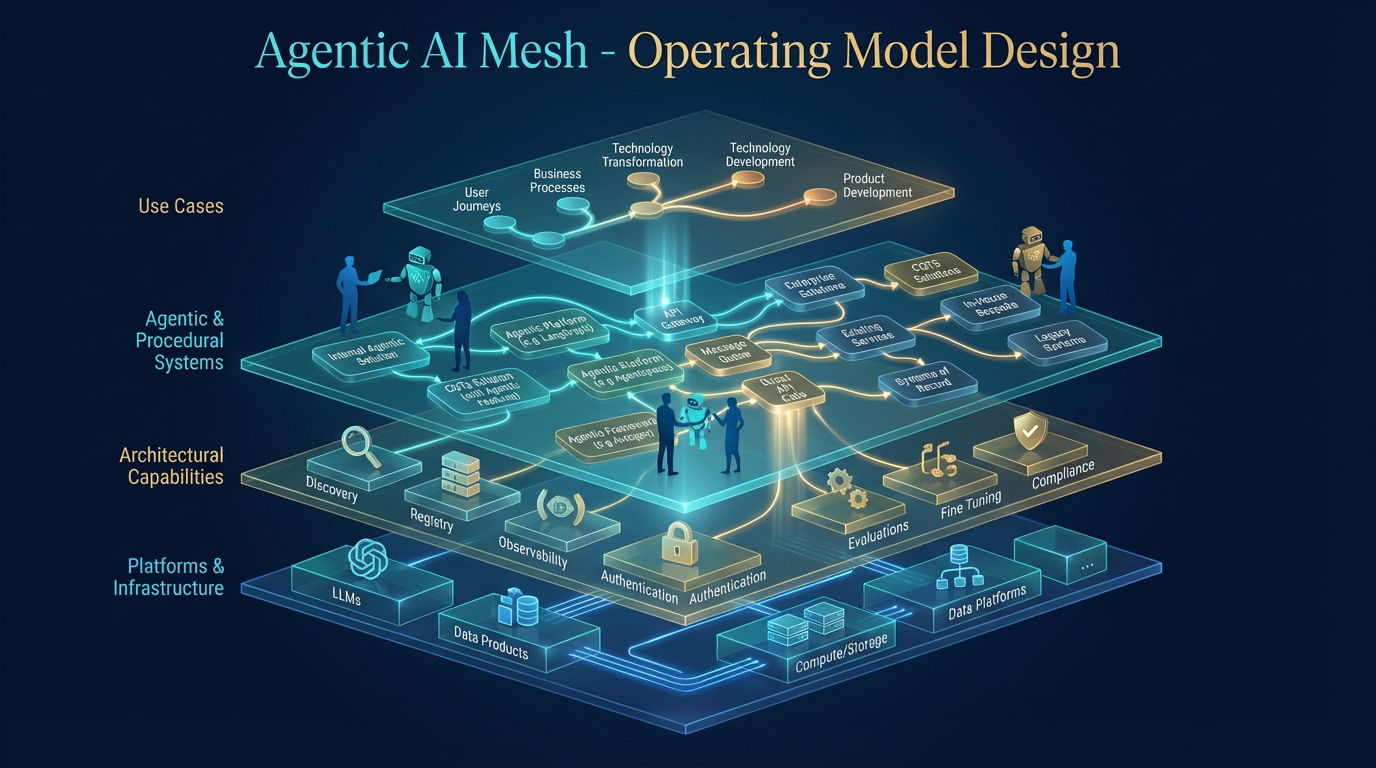
Business architecture is a comparatively mature discipline. It gives organizations stable, reusable views of capabilities, end-to-end value delivery, information, and organizational structure, and, crucially, the relationships between them.
AI operating models, especially agentic ones, don’t yet have that shared maturity. But the overlap is strong enough that business architecture can become a practical accelerator for AI design and AI architecture.
Here’s the overlap in plain terms: business architecture helps us understand which outcomes matter, for which stakeholders, and which capabilities and resources must be organized to deliver them. Agentic AI introduces a new kind of resource, digital labor (agents), which means parts of the operating model can be reconfigured faster.
The catch: it only makes sense for the right jobs-to-be-done, and it still requires disciplined design.
The maturity gap: BA has the maps; AI often has the demos
A lot of AI initiatives start with tooling (“deploy agents”), and only later run into basic enterprise questions:
- Which outcomes matter most, and how are they measured?
- Where does AI help versus add risk, cost, or coordination overhead?
- Who is accountable when the system is non-deterministic?
- How do we avoid dozens of conflicting agent workflows?
Business architecture already exists to answer these questions because it creates shared enterprise transparency through stable views and mappings. Agentic AI needs the same discipline to scale safely and coherently.
Why BA thinking is the foundation for intelligence, flow, and agentic behaviour
When you zoom out, the strongest overlaps between BA and agentic AI fall into a handful of design moves.
1) Value creation and capture → Flow engineering
Business architecture forces clarity on end-to-end value delivery and where value is created and captured.
In AI terms, that becomes flow engineering: designing the “agent journey” that stitches resources together to deliver a JTBD outcome.
A simple pattern is enough to make the idea concrete:
- sense → think → act → learn
The difference between a clever agent and an enterprise-grade agent is simple: traceability to value. If you can’t connect the agent’s actions to measurable outcomes, you don’t have a capability, you have a demo.
2) Value system and ecosystem design → Multi-agent ecosystem orchestration
Business architecture also trains you to think in systems: how flows interact across teams, channels, partners, regulators, and constraints. It’s where you avoid local optimization that creates downstream pain.
Agentic AI introduces a similar challenge, just faster and more dynamic. Multi-agent ecosystems are about optimizing coordination across autonomous actors (agents + humans + vendors + systems) operating in a shared environment.
Think of “airport operations”: passengers, aircraft, crews, gates, security, baggage, weather, air traffic control. You don’t optimize one queue; you optimize the system. Agentic solutions behave the same way. If you only optimize a single agent’s workflow without understanding the surrounding ecosystem, you will offset value somewhere else.
3) Operating system design for outcomes
This is where business architecture becomes essential: agentic AI isn’t just automation, it’s a new operating layer. And every operating layer needs an operating system.
A useful way to frame it is three lenses (in no particular order):
Resource Mix → Capability Mix → Decision Mix
3.1 Resource Mix (who does what, when, where, and how)
In business architecture, reliable outcomes depend on the right combination of people, process, technology, data, policies, and controls. In agentic AI, the “delivery recipe” expands to include model choices, skills, tool access, knowledge sources, evaluation/monitoring, and safety constraints.
Operating models have always been about choosing the right resource mix. Now there’s a new capacity type: digital labor. Depending on granularity, agents can be:
- a pooled resource (like a team) handling workload, and/or
- a capability embedded in a flow (triage, summarize, decide, explain).
The design challenge is not “where can we add agents?” but how to combine humans, deterministic systems, and agents to deliver outcomes consistently.
3.2 Capability Mix (what work is performed, and why it matters)
Capabilities provide a strategic language for what the organization must be able to do to deliver outcomes and value propositions, independent of org charts or tools.
In an agentic context, the capability mix clarifies:
- which capabilities are differentiating vs commodity,
- which should be standardized, automated, or augmented, and
- which must remain human-led due to risk, judgment, or accountability.
This prevents the common trap of designing around tools rather than around the business abilities required to deliver value.
3.3 Decision Mix (which decisions exist, and how they’re governed)
This is where most agent programs stumble. Agentic systems don’t just execute tasks, they make and sequence decisions. So the operating system must define decision rights and coordination mechanisms.
Human–agent choreography typically needs:
- routing and handoffs
- escalation paths
- approval points (human-in-the-loop vs on-the-loop)
- exception handling and “stop rules”
- accountability (who owns the outcome?) and auditability
Autonomy without decision design is how you get inconsistent behaviour, unmanaged risk, and unclear ownership.
4) Outcomes combine into value propositions → Compositional intelligence
Value propositions aren’t single outcomes. They’re bundles of outcomes that work together to deliver a coherent promise.
In AI terms, this is compositional intelligence: agents assembling the right sequence of capabilities and resources for each intent, especially when no single known solution exists.
This is where “agentic” becomes real: planning + tool use + verification + adaptation, not just chat.
5) JTBD gains and pains → Intent, experience, and trust engineering
Business architecture’s JTBD lens keeps you anchored in outcomes: what people are trying to achieve, which gains matter, and which pains you remove.
Agentic AI adds a crucial overlay: trust requirements. Not everything is “automate it.” You need clarity on what must be verified, what requires approval, what must be logged, and what error profile is acceptable.
In short: value proposition engineering becomes flow + behaviour engineering for AI.
6) Re-org cycles → BizOps / StratOps
Re-orgs are attempts to realign resources to outcomes as strategy and conditions change.
Agentic systems can accelerate iteration into a “DevOps for work” loop, call it BizOps or StratOps. Instrument outcomes, adjust flows, reconfigure capacity, tighten controls, ship updates safely.
The key is governance. Without it, you don’t get agility, you get agent sprawl.
7) Humans used to make it slow → the bottleneck shifts
Execution can speed up dramatically. But adoption, accountability, compliance, incentives, and skills are still human-limited.
So the bottleneck moves from “can we build it?” to “can we trust it, govern it, and embed it into how we run the business?”
The Value vs Complexity matrix: the simplest guardrail that prevents wasted AI
Most AI strategy fails because it treats all work the same. A simple 2×2 helps:
X-axis: value potential (low → high) vs Y-axis: complexity/variance (low → high)
- High value + low complexity: deterministic automation (with AI for extraction/UX).
- High value + high complexity: agentic + human supervision by design.
- Low value + high complexity: contain/outsource/assist—don’t overbuild.
- Low value + low complexity: simplify first; deletion is the best automation.
This single view prevents the most common mistake: pushing agentic solutions into work that should be standardized, or under-designing the work that actually needs adaptive systems.
Starter kit (high-level): how to approach it without boiling the ocean
- Start with value proposition design: value creation and capture.
- Wrap it into a JTBD framing: outcomes, measures of success.
- Map end-to-end stages and define value per stage.
- Identify the capabilities required at each stage.
- Shape an operating model at a high level: roles, handoffs, decision rights, governance.
- Apply Value vs Complexity to choose automation strategy across JTBDs and capabilities.
- Design for the system: ensure streams don’t offset value elsewhere.
- Roadmap the pathway: sequence adoption, reuse, and governance maturity.
Closing
Agentic AI makes new operating models possible, but it also makes weak design visible fast.
Without a shared map of outcomes, value flows, capabilities, and decision rights, organizations end up with disconnected agents, inconsistent behaviours, and local optimizations that erode system performance.
Business architecture is the stabilizing layer. It anchors intelligence in value, turns agent behaviour into reliable flow, and makes autonomy governable.
In the agentic future, the winners won’t be the organizations with the most agents. They’ll be the ones that can design intelligence as an operating model.
Note: AI was used to summarise and improve flow