
AI is getting dangerously close to “gym influencer” territory.
Every feed. Every ad. Every brand-new self-declared expert telling you the future is this app or that prompt. And meanwhile, you’re sitting there thinking:
“Cool. But how do I make this work in my organization… with my mess… and my stakeholders?”
Because that’s the part nobody puts on LinkedIn.
The hard work—the value—lives in the unsexy places:
- incubation and scaling
- data pipelines and provenance
- operating models and governance
- evaluation and monitoring
- orchestration across multiple agents and tools
If you’ve felt a creeping sense of overload lately, you’re not alone. The organizations that win won’t be the ones with the most AI apps. They’ll be the ones who can design and operationalize intelligence—reliably, safely, and at speed.
The shift that’s already happening (whether we like it or not)
Most teams are still treating AI like a feature: “Add a chatbot.” “Summarize documents.” “Automate a workflow.”
But what’s emerging now is bigger: multi-agent systems (MAS)—multiple specialized agents coordinating to solve complex, shifting problems.
This is the difference between:
- automating a process once, and
- building a living system that adapts continuously.
And if you’re in a complex environment—government, finance, infrastructure, health, logistics, central banking, aviation—your work is already MAS-shaped. You just don’t call it that yet.
The quiet shift underneath: prompt → flow → behaviour
The industry is also moving through a very practical maturity curve:
1) Prompt engineering (single-turn optimisation) Crafting the best instruction to get the best output from a single model interaction. Great for drafts, summaries, extraction, Q&A—until the work gets messy.
2) Flow engineering (linear agentic automation) Designing multi-step orchestrations: route → retrieve → write → verify → act. This is where “agents” start to look useful, because you’re engineering outcomes across a sequence.
3) Behaviour engineering (MAS societies) Designing the behaviour of a society of agents over time—under constraints, uncertainty, and change. Here you’re no longer optimising a prompt or a flow; you’re designing coordination: shared state, policies, governance, feedback loops, and adaptation.
The real frontier: We’re moving from mixing prompts to achieve outcomes → to mixing outcomes to produce reliable system behaviours.
Why MAS matters (and why most MAS initiatives stall)
Multi-agent systems thrive when the problem looks like:
- multiple stakeholders with competing objectives
- unclear cause-and-effect
- exceptions everywhere
- shifting priorities and constraints
- work that behaves more like a negotiation than a flowchart
In plain English: real life.
The reason MAS initiatives stall isn’t the tech. It’s mindset.
Traditional digitization is linear: define the process → automate steps → enforce compliance → optimize throughput
That works when the world is stable. But knowledge work isn’t stable—so organizations end up with:
- app sprawl
- brittle automation
- escalating integration costs
- “shadow workflows” built by teams trying to survive
MAS flips the model: don’t hard-code the “one true process” organize a society of roles that coordinate and adapt in the moment
It’s not “automation of activities.” It’s coordination of actors.
A scenario that makes MAS instantly obvious: the airport
Imagine an airport trying to optimize the flow of people off an aircraft and into ground transport.
At any moment, you’re juggling:
- inbound flight waves (passenger volumes changing by the minute)
- immigration throughput and staffing constraints
- baggage belt availability and failures
- curbside congestion, dwell times, and ride-share spikes
- road incidents that choke capacity
- the ability to change traffic lights, open/close lanes, re-route pickups, or introduce micro-delays
There is no single “process” that covers this. There’s intent, constraints, trade-offs, and real-time decisions.
That’s MAS territory.
The biggest trap: trying to design MAS with linear tools
Most design and architecture methods assume:
- one stable journey
- one correct sequence
- one process map to rule them all
But MAS is different:
- non-linear
- event-driven
- adaptive
- distributed decision-making
- governed by policies, not flowcharts
So the real question becomes:
How do you design for a self-organizing, autonomous environment without losing control—or losing the plot?
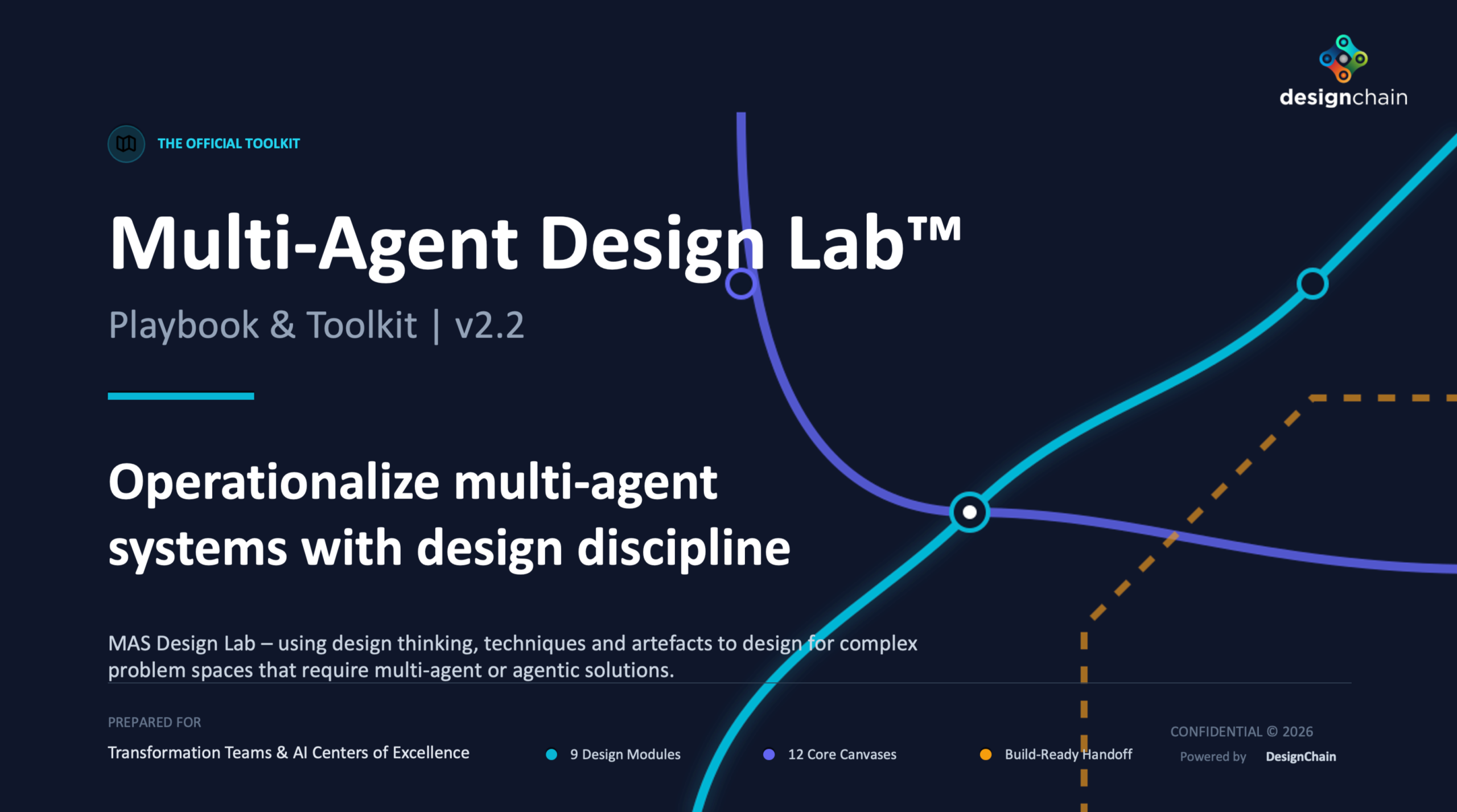
That’s exactly what MAS Design Lab™ (MASLab) is for. Because MAS doesn’t fail due to “lack of prompts.” It fails due to lack of design discipline.
Multi-Agent (MAS) Design Lab™ — choose your runway
We offer three delivery formats depending on how far you need to go—from alignment, to build-ready specs, to MVP support.
1) Executive Intensity — 2-Day Sprint
Best for: strategy teams and leadership alignment You’ll get:
- Readiness assessment (Fit Map)
- Intent + job mapping
- Agent role definition
- Light “line” sketch (concept route)
Outcome: a shared direction and a credible high-level concept—without boiling the ocean.
2) Comprehensive (Recommended) — 5-Day Sprint
Best for: product teams and architects ready to build Everything in the 2-Day Sprint, plus:
- Full outcomes + signals register
- Detailed agent behavior cards
- Blackboard coordination simulation
- Architecture handoff pack
Outcome: a tested design prototype of the agent ecosystem and the success “lines” you can implement in frameworks like LangGraph and AutoGen.
3) Incubation — 3–4 Weeks (Full + Coaching)
Best for: enterprise orgs launching their first MAS Everything in the Sprint, plus:
- MVP scope refinement
- Architecture pairing sessions
- Governance + policy setup
- “First Train” pilot support
Outcome: you don’t just leave with a blueprint—you actually get the first line moving toward MVP.
Note: All formats include access to the full Canvas Library.
Call to action (pick your next step)
- Click the Toolkit link to access the paywalled Toolkit and template library.
- Head over to Contact and reach out to us if you are looking for a “SPRINT” and we’ll recommend the right runway (2-Day, 5-Day, or 3–4 weeks) based on your context—no fluff, just a tailored plan.
Note: Article optimized by AI (and by scars earned in complex programs).