
MIT says 95% of AI pilots return nothing. I spent 2025/2026 inside fifteen of them and found the same six problems every time. None of them was the model.
The question from the back of the room
Earlier this year I sat in a boardroom and watched an assistant draft a case summary in about forty seconds. The room loved it. Someone said “we want more of this” and everyone nodded, including me.
Then a quiet voice from the back asked two questions. Where does it keep what it knows? And who said it could act? Nobody answered. Not the vendor, not the IT lead, and, if I am honest, not me, not properly.
I have been circling those two questions ever since. I put a version of this on stage at a recent conference, and this is the written-up version. The first question is about memory. The second is about governance and skills. Between them, I think they explain why most AI pilots never leave the demo environment.
Let me set the scene.
I keep getting called in at the messy end
The multi-agent idea is not new to me. In the early 2000s I built Synap-c, a multi-agent, self-organising complex adaptive system, before cloud and before large language models. It used swarm intelligence and genetic algorithms to work on problems that were complex by nature rather than complicated: traffic control, people movement, frequency optimisation, supply chains, networked warfare. We were, in other words, doing agents before agents were cool. The idea held up. The tooling did not, for about twenty years.
What changed in the last eighteen months is that the intelligence layer caught up with the architecture. A planner can now read a policy, and a skill can draft a document. So the self-organising patterns I was drawing with swarms are suddenly buildable in an ordinary enterprise, and I have spent the year doing exactly that, across three or four large institutions: development finance, central banking, an ethics and justice functions, environmental and social risk and central banking. I will not name any of them. The patterns are what travel.
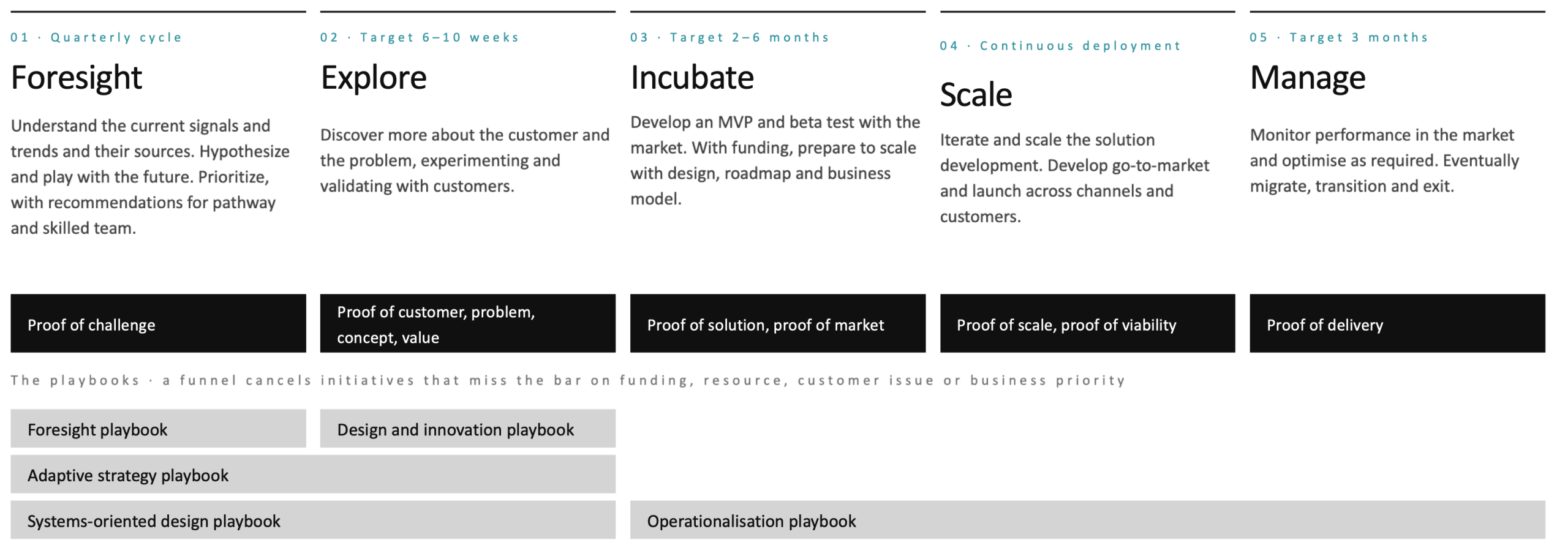
Here is the thing worth noticing about those engagements. Almost all of them started at Explore, the stage of our signal-to-value chain where the problem is not understood, the solution is not agreed and the stakeholders do not share a picture.
Nobody runs a design sprint on payroll. You run one when you are lost, and that tells you something about the work: it was complex, in Dave Snowden’s sense of the word, the domain where cause and effect only make sense afterwards.
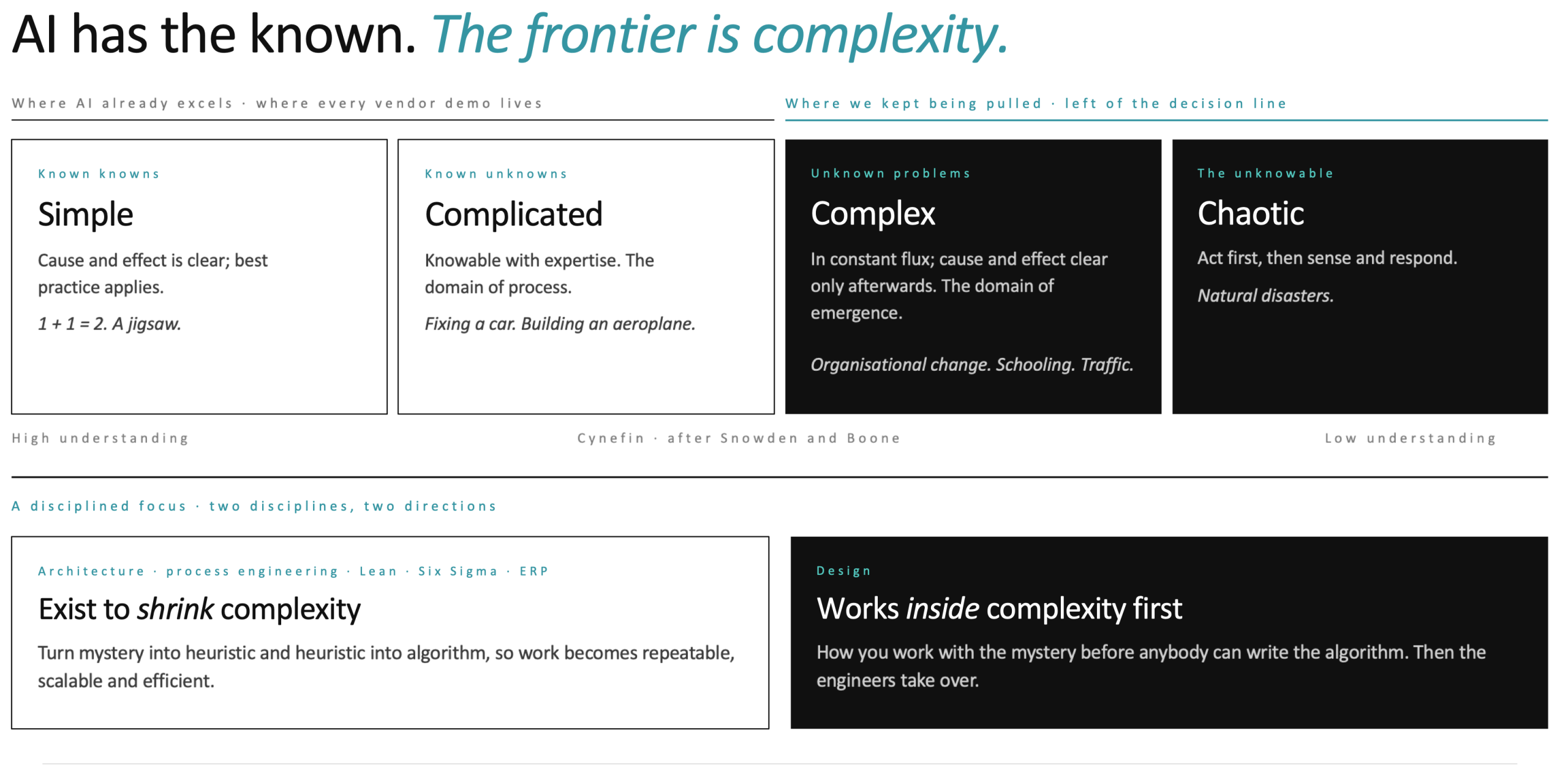
AI already excels in the simple and complicated domains. That is where every vendor demo lives. The work that came to us lived in the top-right of the value-by-complexity picture, high value and high complexity, and the instinct of every architecture and process team I met was to push it down the funnel: make it complicated, document it, build a screen, automate.
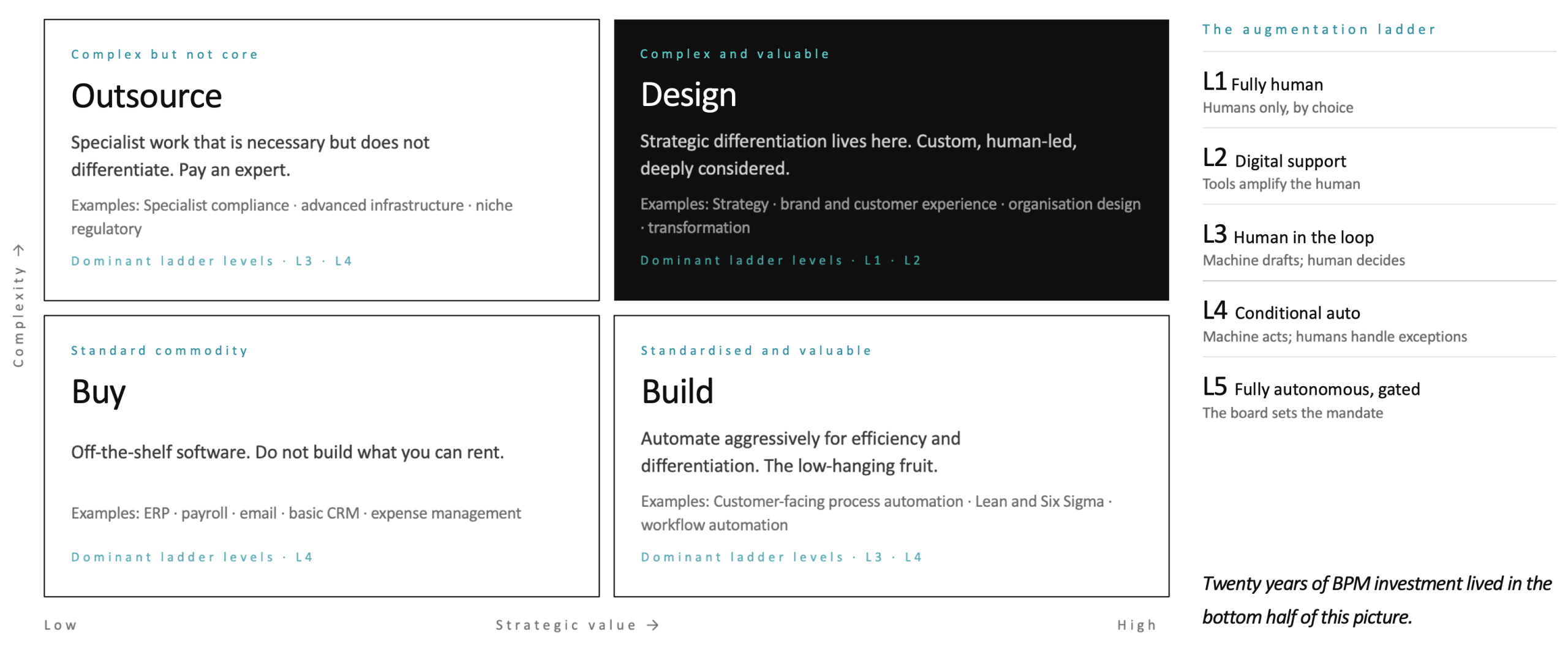
Twenty years of BPM investment sits in the bottom half of this picture, and it was right for its time. The catch: the machine can now work inside complexity too. Is the old funnel still the right move? I reckon not always.
Six things we found, every single time
Strip the department names off and the same six things showed up on every programme.
- The core systems had become governance gateways: where work was approved and filed, not where it was done.
- The real work happened in documents, email, chat and meetings, and got uploaded at the end, if at all.
- The documented process lived in the application while the real one had moved on, and nobody had re-documented it.
- IT was still commissioning forms-based screens while the users did all the work in the collaboration tools.
- By the time a record existed it was history.
- The memory of the organisation, the why behind every override and exception, walked out of the building at five o’clock in people’s heads.
On roughly nine in ten of those programmes, the first pattern alone was the central problem. In other words:
the way of working had moved. The architecture had not followed it.
MIT found the same thing, with better sample sizes
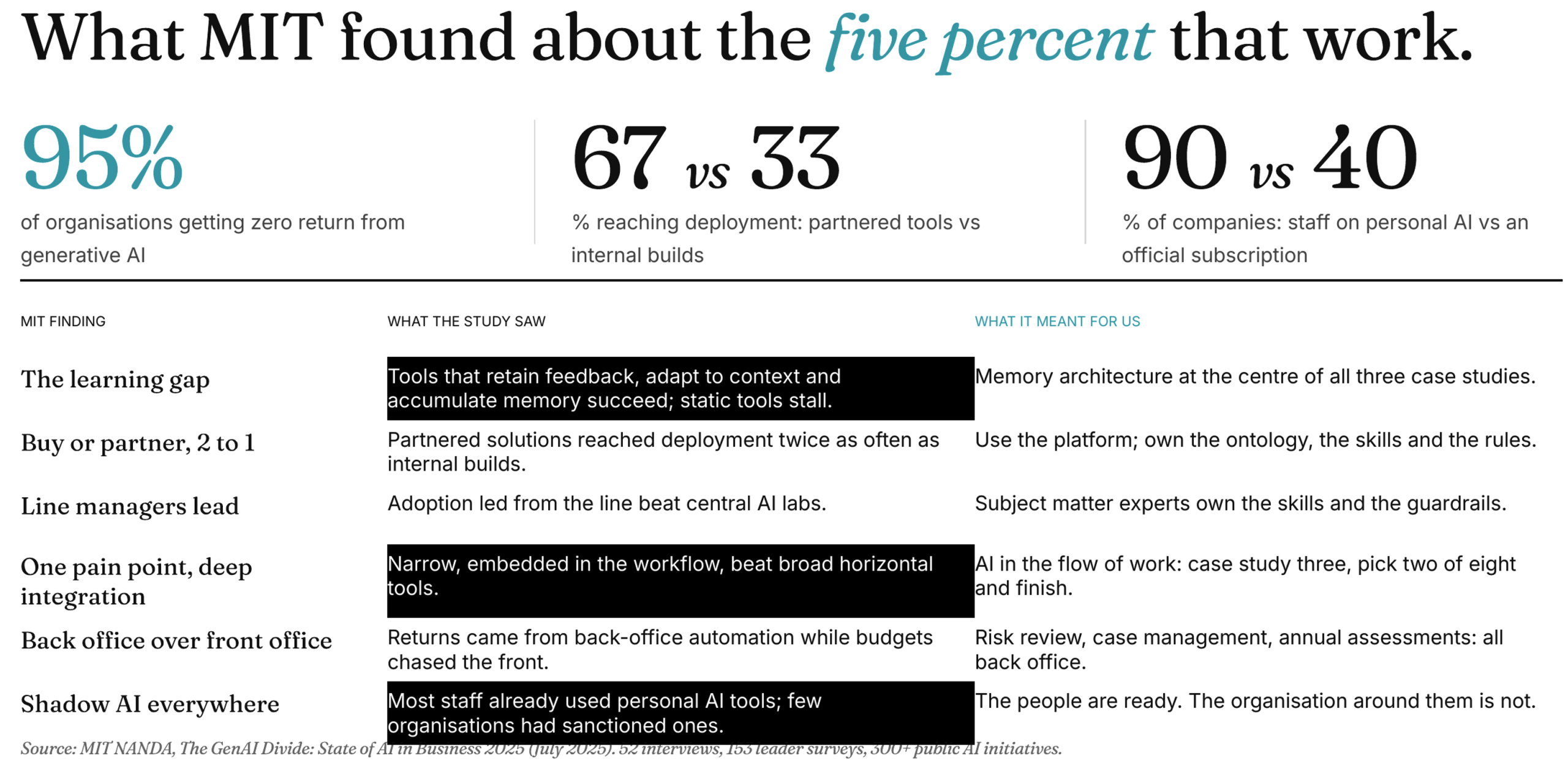
I was not working in a vacuum. MIT’s 2025 study, The GenAI Divide, put the failure rate at around 95% of organisations getting no measurable return from generative AI. The 5% that succeeded shared traits, and three of them matched what I was seeing almost word for word.
The first MIT calls the learning gap: tools that retain feedback and accumulate memory succeed; static tools stall. That is the back-of-the-room question, where does it keep what it knows, as a research finding. If you do not build systems that learn, you are not growing the knowledge of the institution. You have bought a better search box.
The second is narrow and deep: one pain point, embedded in the workflow, beat broad horizontal platforms. I call this AI in the flow of work. The old move is to pull people out of the way they work and send them to a system we think will help. The 5% did the opposite and took the AI to where the work already was. Our host at the conference put it better than I have: it is not bringing the people to AI, it is bringing AI to the people.
The third is shadow AI. Staff at over 90% of companies were using personal AI tools; 40% of companies had bought an official subscription. I saw the same everywhere. If shadow IT was a problem, shadow AI is that problem with citizen developers who can build an agent in an afternoon. Every central IT function that answered with one master platform ran slower than the business it was meant to serve.
The people are ready. The organisation around them is not.
Two routes out of the top-right corner
Faced with complex, valuable work, you have two routes.
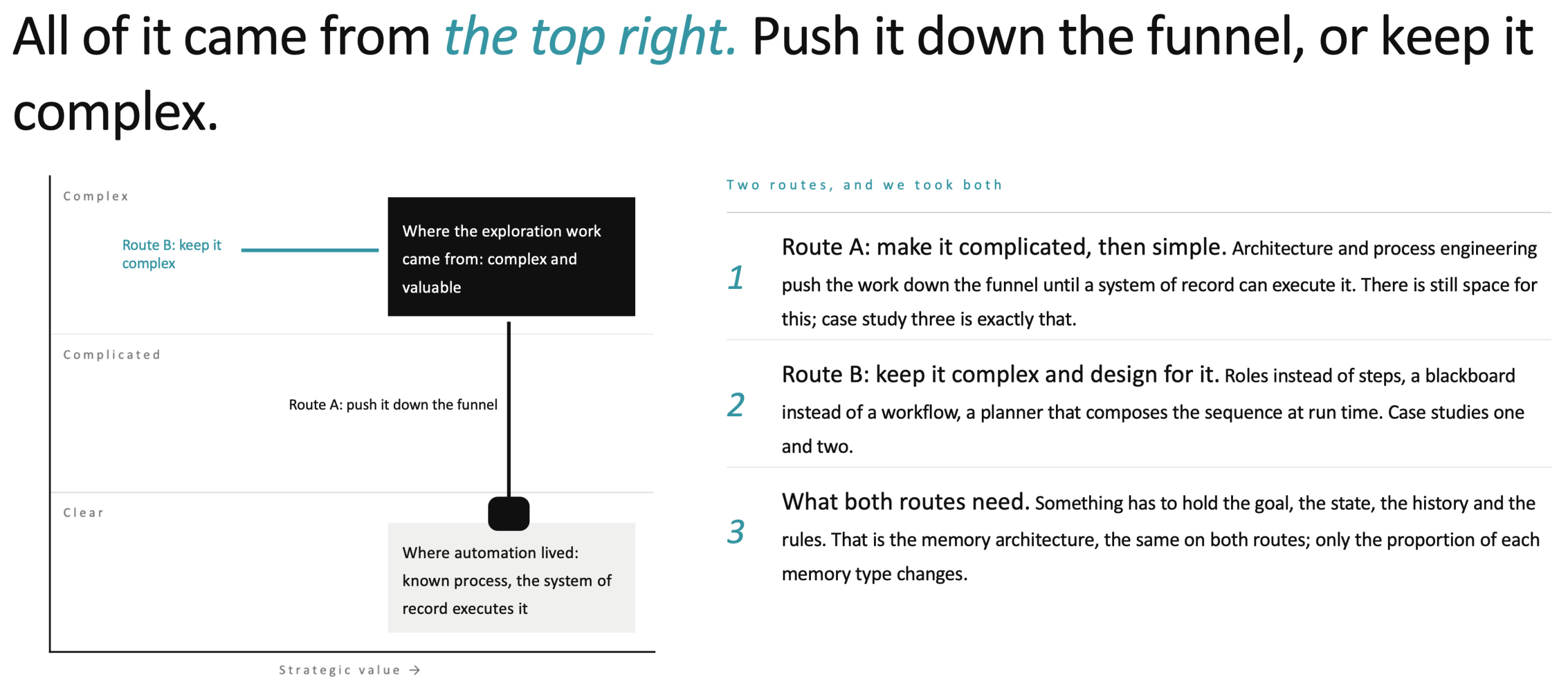
Route A is the one everybody knows. Run a design activity, extract the rules of thumb, document the process architecture, build a screen, automate. Push the work down the funnel until a system of record can execute it. There is still space for this; one of my three case studies is exactly that.
Route B is the one that unsettles people. Keep it complex, and design the architecture to cater for complexity rather than remove it. Roles instead of steps. A blackboard instead of a workflow. A planner agent that composes the sequence at run time from the goal and the state. When I tell a design team “there is no user interface and there is no known process, now solve it”, I can watch the mental gears strip. That is not a criticism of the teams. Our own discipline has a learning journey to go on here, and most organisations are not yet mature enough for Route B. I believe that is where they need to go. I also believe you say so plainly.
Here’s the bridge between the two: something has to hold the goal, the state, the history and the rules. That is the memory architecture, and it is the same on both routes. Only the proportion of each memory type changes.
Three case studies, three positions on the spectrum
The first was MASLab, a multi-agent design sprint we built because nothing on the market was multi-agent in its thinking. We built an agentic ecosystem for a programme managing projects across many countries and many suppliers, gave the system an intent rather than a process, and let it self-organise underneath.
Think of the London Underground. You want to get from east to west, so you plot a route across lines and stations, changing where you need to. A multi-agent environment works the same way: stations are agents, lines are the pathways between them, signals are the metrics that say a station needs attention.
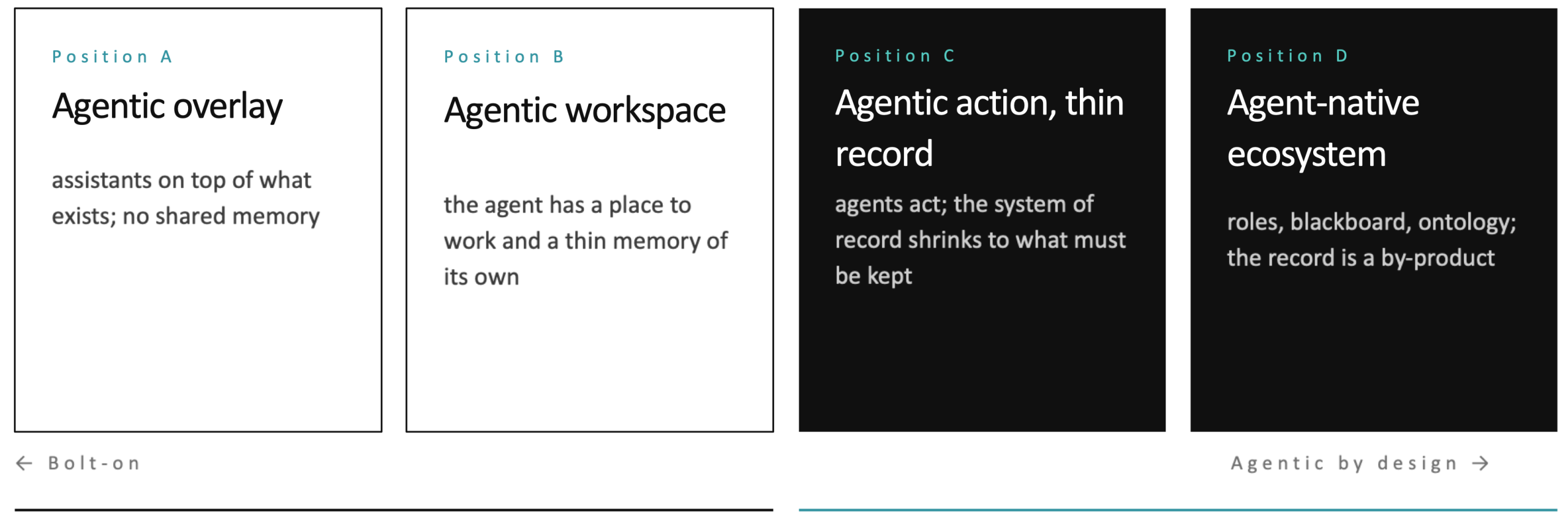
It ran on a graph-based agent runtime and it worked. It was also, candidly, a bridge too far for the organisation: position D on the spectrum, agent-native, before anybody had lived at A, B or C. The sprint method survived. The platform was about a year early.
The second was an M&A synergies programme: seven hundred practitioners, four operating models with associated systems and data, no single process gluing it together. Rather than build a fifth system, we designed a memory architecture, using the CoALA architecture (Cognitive Architectures for Language Agents) from Sumers and colleagues at Princeton as the vocabulary. Working memory is the live state of the case. Episodic memory is what happened and why, written back when a case closes. Semantic memory is what the institution knows: the ontology, the glossary, the knowledge graph. Procedural memory is how work is done, which the market now calls skills.
The shift that hurt the client most was this:
the system of record no longer sits in one database. It sits across all four memory layers.
A structured record here, a PDF there, an episode from somebody’s long-running chat, a versioned skill. On top of that memory we put a blackboard. Every role, human or agent, posts to it and reads from it; nobody calls anybody; the orchestrator watches the state, not a script. We role-played it in the workshop with post-it notes, which is how the design team finally stopped drawing swimlanes.
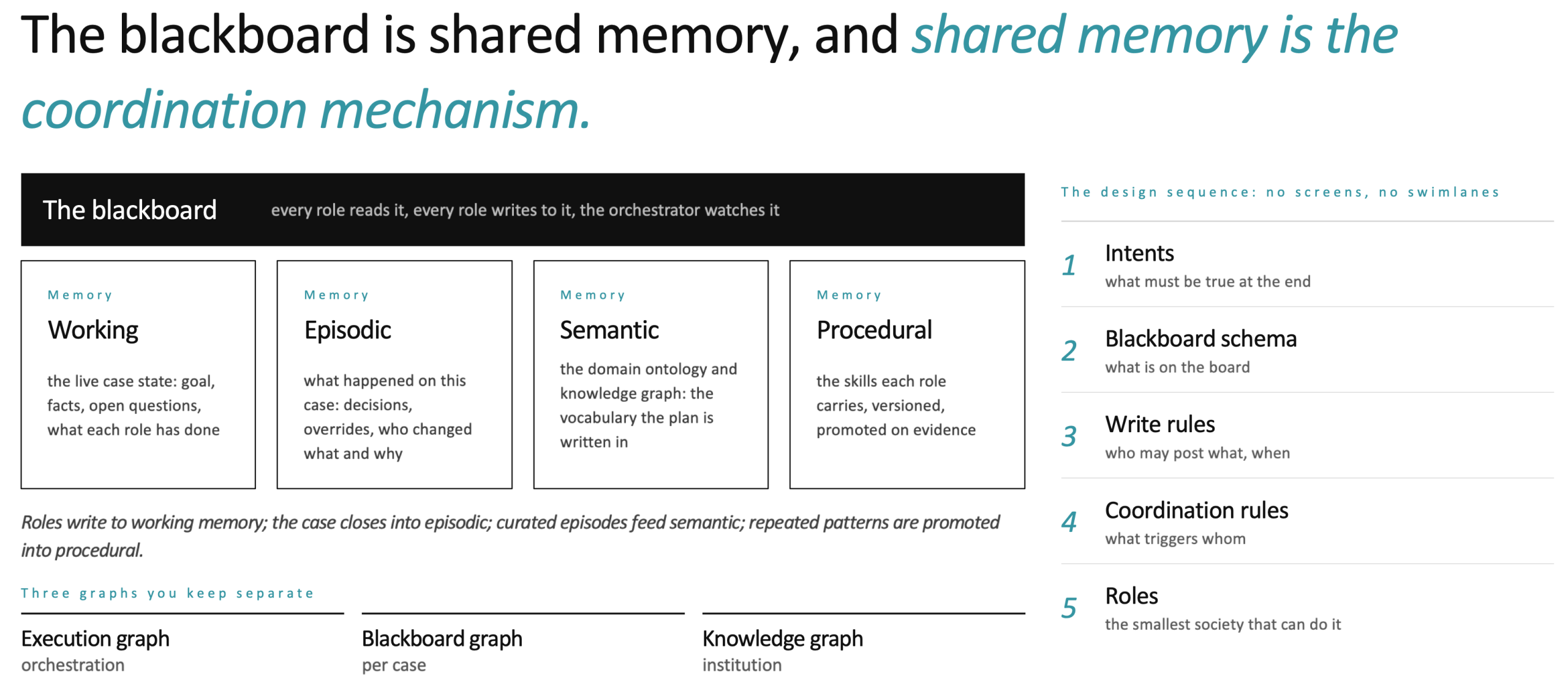
The constraint I set at the start was the whole method. “You cannot design a user interface, and you do not know the process.” If the memory is built properly, the planner works out the plan and comes back to you for approval. Ouch, said the room. Then they did it. Getting them to move the mindset from linear UI driven problem solving to non-linear, shared memory was a difficult ask for a low maturity organisation. And yet this way of thinking is essential to creating the foundations for the intelligence ecosystems of the future.
The third was an operating model unification: a department with nine services that wanted to work as one, and needed repeatable processes and a system of record. Route A, deliberately, but built agentic by design so that moving along the spectrum later would not mean a rebuild.
The metaphor that landed was a restaurant kitchen. Their process model is the recipe book, one recipe per dish, and every dish still comes from it. But a busy kitchen does not run from a recipe book alone, because orders do not arrive in recipe order. So the kitchen runs on three other things. The kitchen rules, which was a permission table of 129 rows: who may do what at which station and when, with an authority rung, a guardrail reference and a sensitivity class on every row. The shared equipment, which is the skill catalogue: the 41 AI gadgets pinned to recipes on their poster turned out to be 12 shared appliances, cheaper and safer to maintain, each requiring their own skill to operate. We then built reconfigured service blueprints to define the service experience seen from all three sides of the pass, journey, frontstage and backstage.
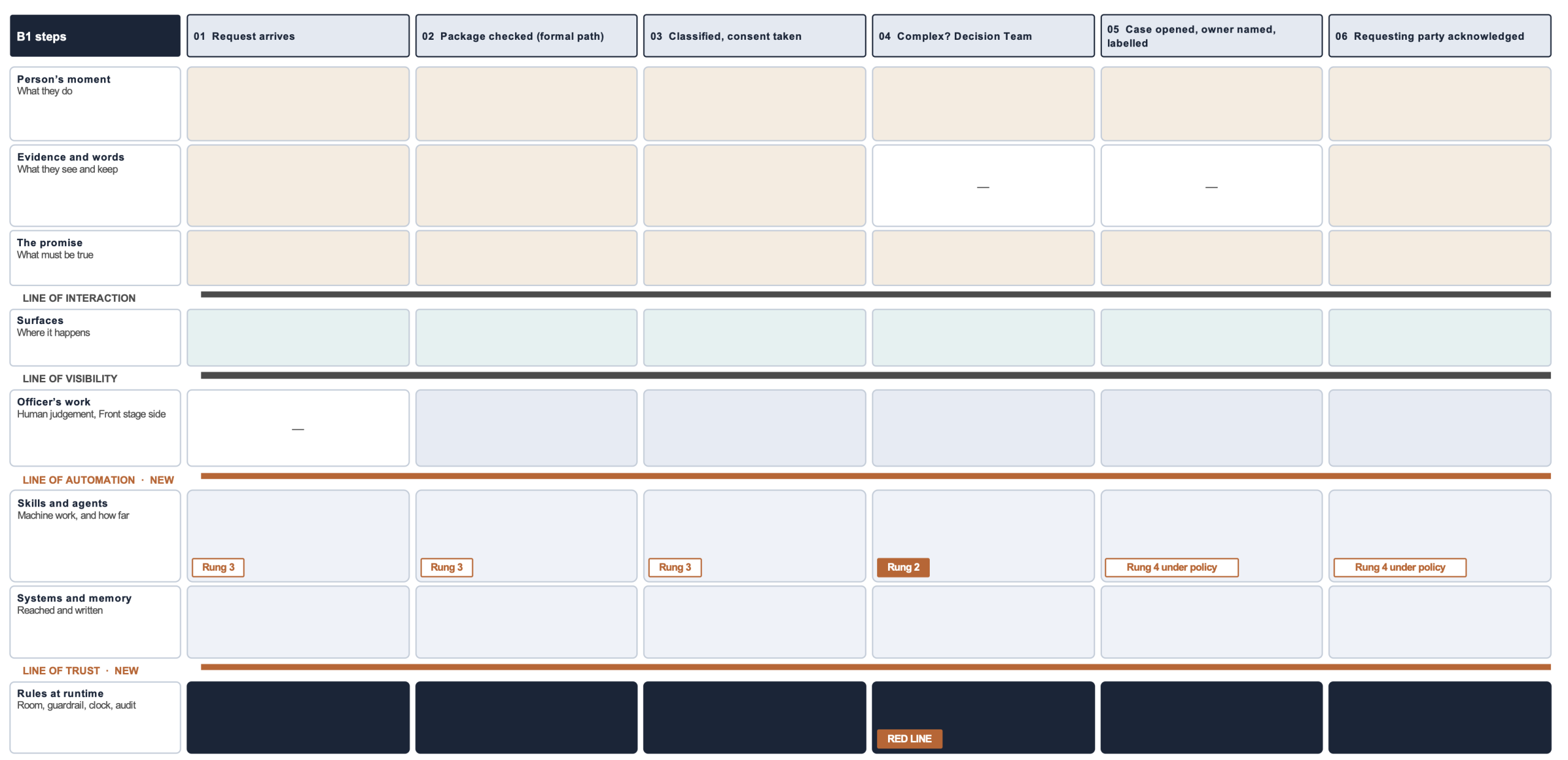
The line I gave them: your process is still the recipe book. We turned it into a working kitchen.
What I now believe about designing for AI
Four things. They are also the skills I now look for when I hire.
Memory is the architecture. CoALA’s four memory types are what separate an agent from a chatbot, and deciding where each one lives in the estate (the collaboration tenant, the system of record, the lakehouse and graph, the skills library) is the first architecture decision, not the last.
Governance runs at the moment of acting, not in a binder. A guardrail with a stable ID that the planner checks before it acts, and an episode that records which rule fired, did more for trust on these programmes than any policy document. It also surfaced fourteen contradictions the policies had been hiding.
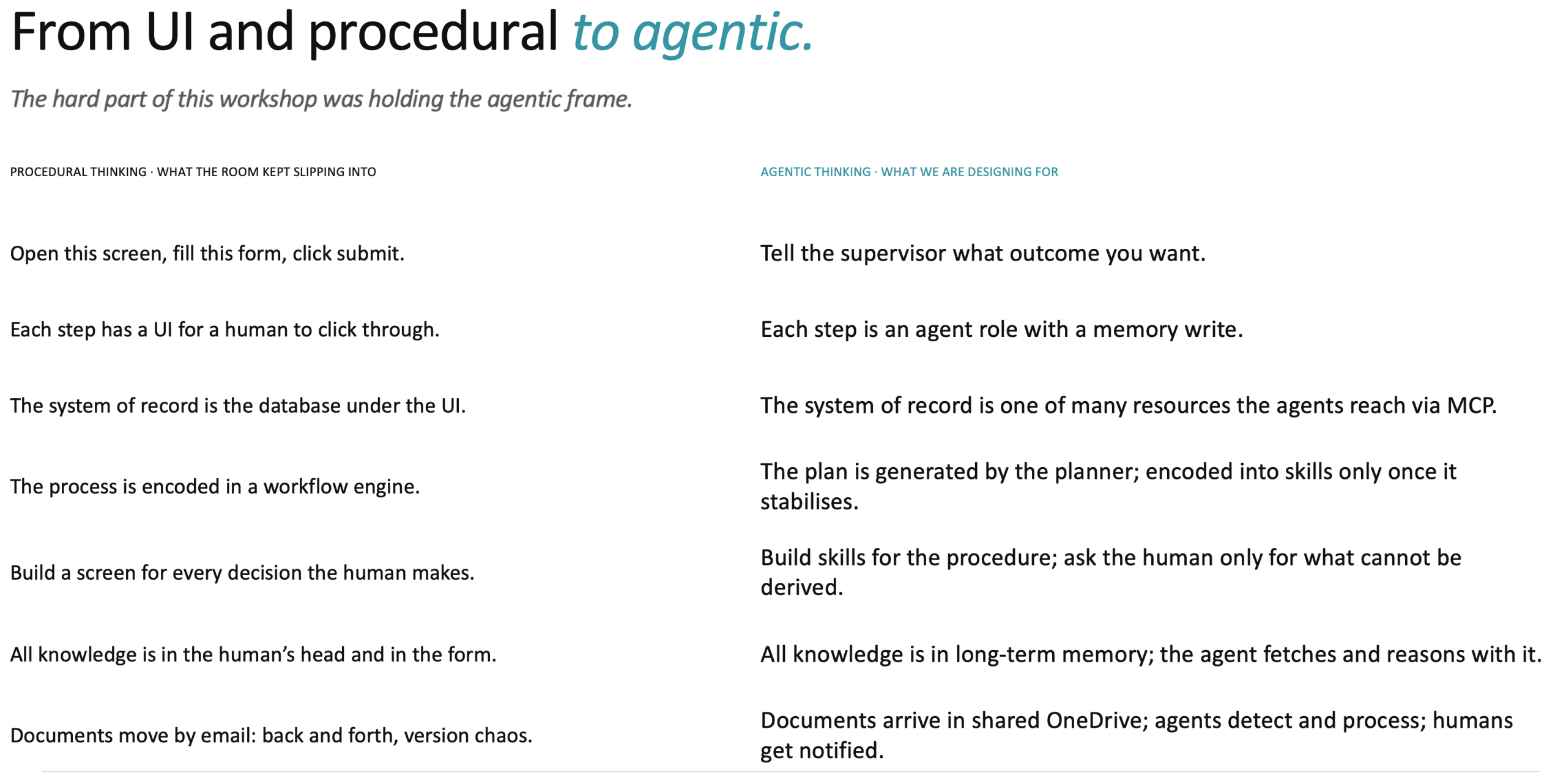
Design for intent, not for screens. Tell the supervisor the outcome you want. Each step is a role with a memory write, not a form. Build skills for the procedure and ask the human only for what cannot be derived. Your process and architecture repositories do not die in this world; they become inputs to the ontology the planner thinks in, which is a bigger role than they have ever had. Provided, of course, they are modelled for a machine to read.
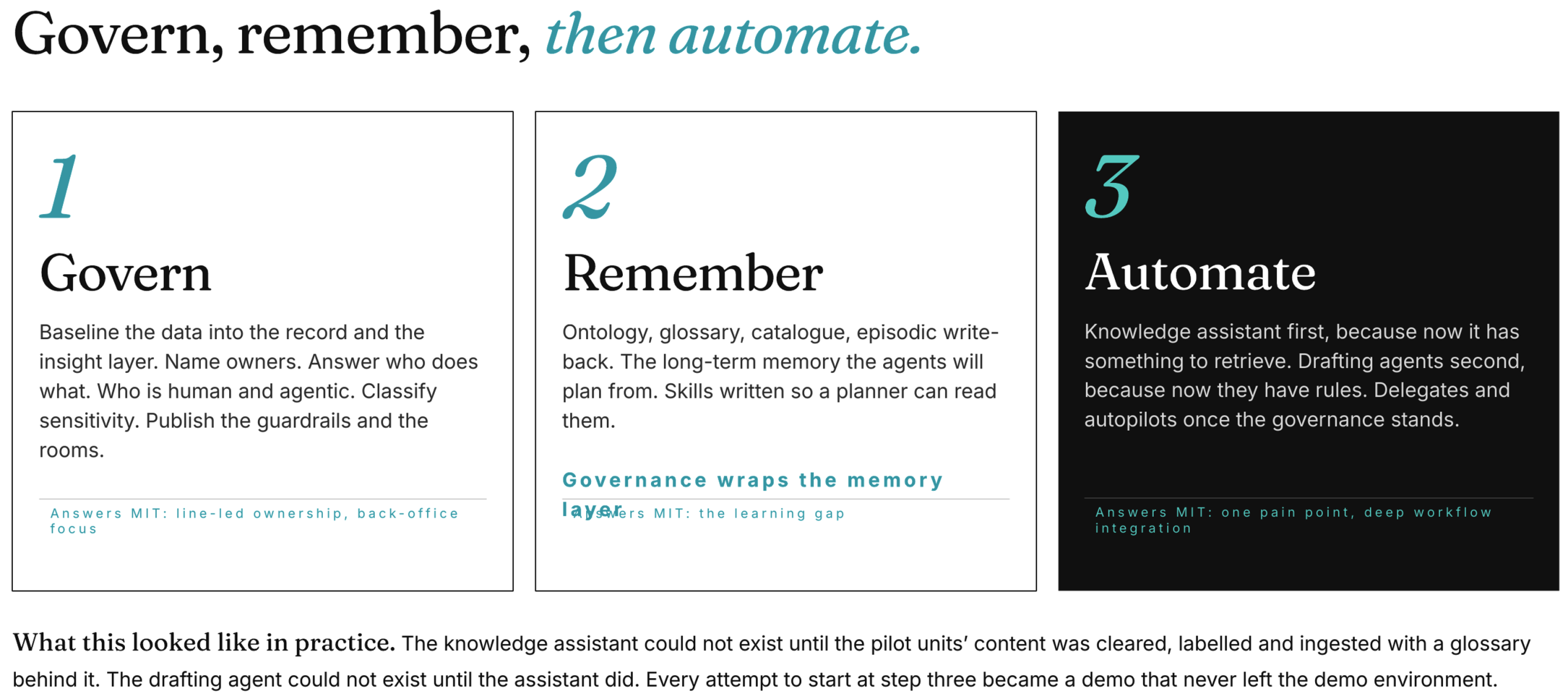
And the order is not negotiable: govern, remember, then automate. Name owners and classify sensitivity. Build the ontology, the glossary and the episodic write-back. Only then the knowledge assistant, because now it has something to retrieve; only then the drafting agents, because now they have rules. Every plan I reviewed that started at automate came back to the first two steps at a higher price, usually after the pilot had already been declared a success.
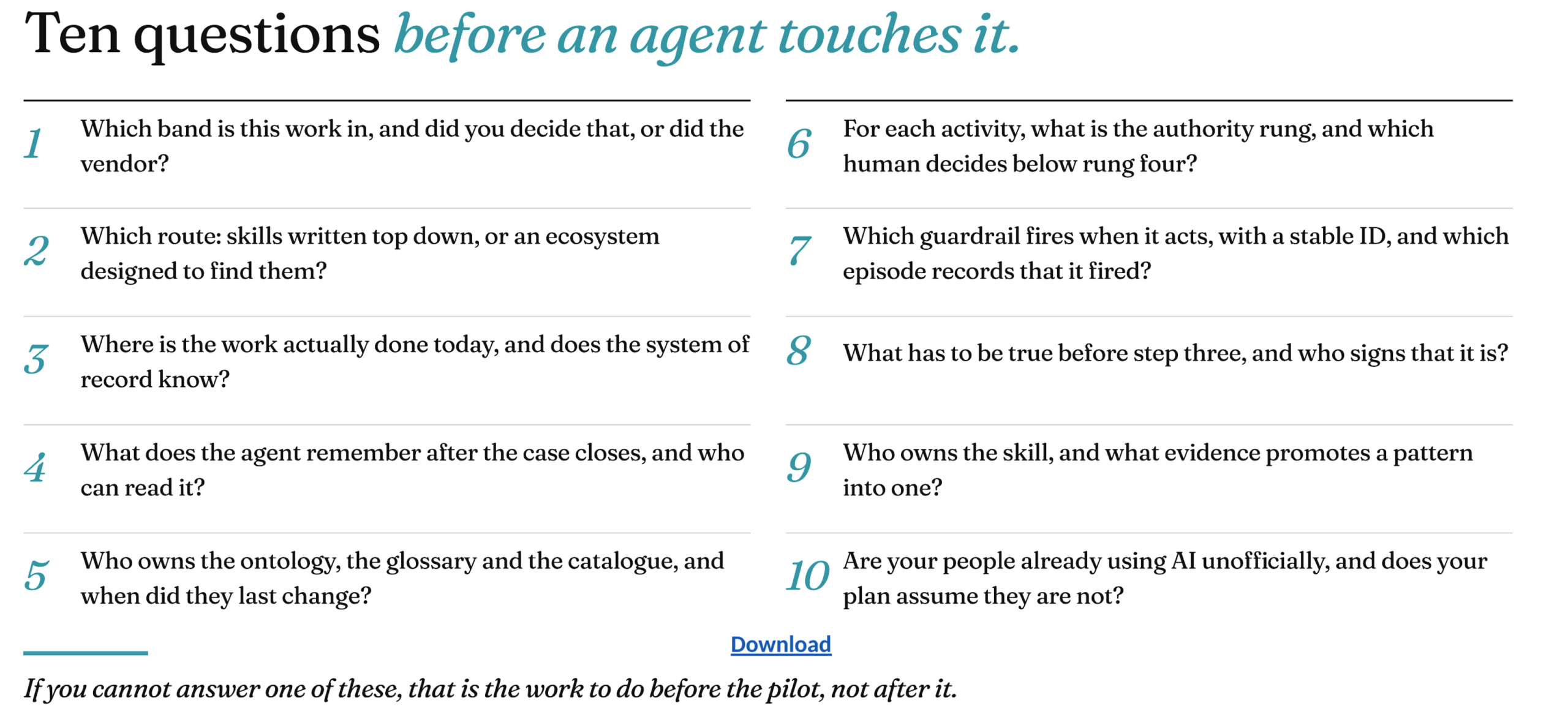
Ten questions before an agent touches the work
I closed the conference with a readiness checklist, now a one-page infographic you can download below. The short version is a set of questions, and I would rather you sat with them than skimmed them. Which band is this work in, and did you decide that, or did a demo? Which route, top down or ecosystem? Where is the work actually done today, and does the system of record know? What does the agent remember after a case closes, and who can read it? Who owns the ontology, the glossary and the skill catalogue, and when did they last change?
For each activity, what is the authority rung, and which human decides? Which guardrail fires when it acts, and which episode records it? What must be true before you automate, and who signs that off? Who owns each skill, and what evidence promotes a pattern into one? And are your people already using AI unofficially, while your plan assumes they are not?
|
Which brings me back to the quiet voice at the back of the room. Where does it keep what it knows, and who said it could act? Twelve months on, I can answer. It keeps what it knows in a memory architecture you designed. It may act because a guardrail with a version number said so, at a rung a human chose.
The winners will not be the organisations with the most agents. They will be the ones whose agents can remember.
Download the Agentic Readiness Checklist : [DOWNLOAD LINK]
READING LIST
MIT NANDA, The GenAI Divide: State of AI in Business 2025. Sumers, Yao, Narasimhan and Griffiths, Cognitive Architectures for Language Agents (CoALA). Snowden and Boone, A Leader’s Framework for Decision Making, Harvard Business Review. L. David Marquet, Turn the Ship Around, on intent-based leadership. Roger Martin (still no relation), The Design of Business, on the knowledge funnel.
Craig Martin is a director at DesignChain, a strategic design and business architecture firm working across Africa, Australia and the UK. This article is drawn from his session at the BOC Conference 2026.